
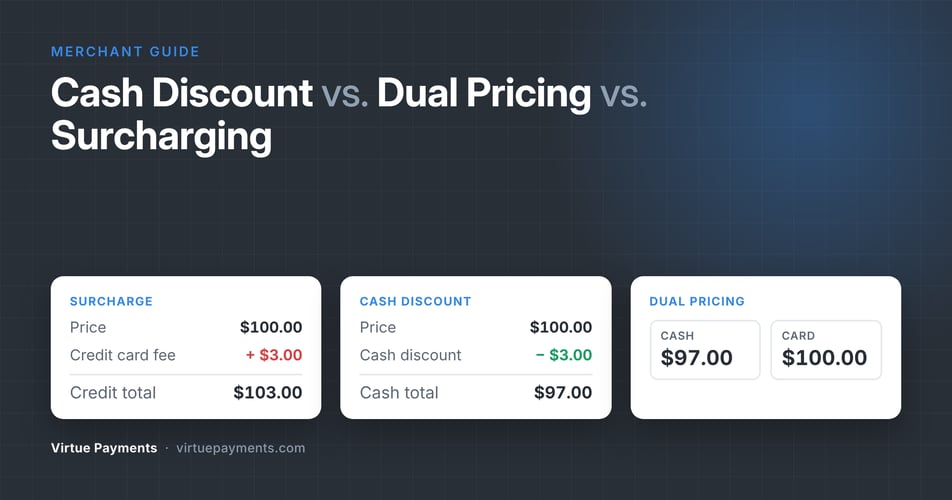
Three Ways to Pass On Card Costs, and Why the Label Matters Card processing fees are one of the...
Why You Can't Surcharge Debit Cards (and How Debit Detection Works)

Erica K.
5 min read.
Surcharging Has a Blind Spot: Debit Cards
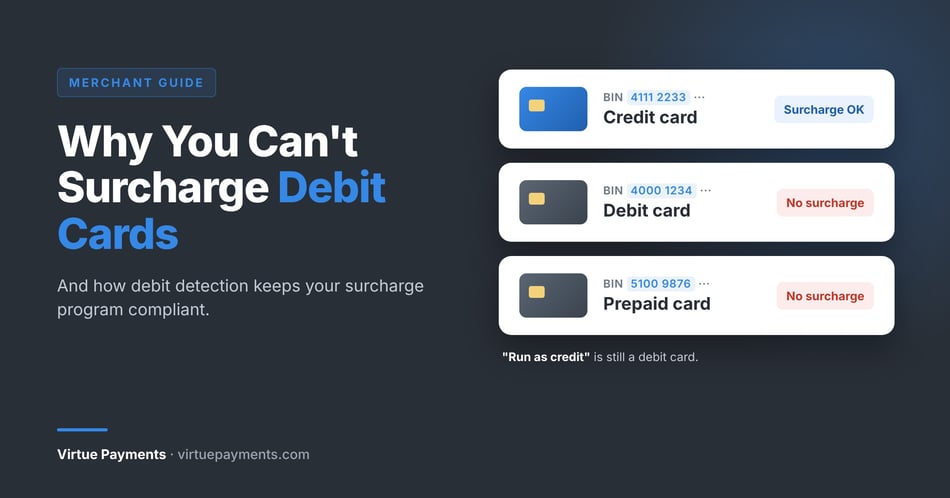
More businesses are adding a surcharge to credit card payments to offset processing costs. It's a legitimate option in most states when it's done correctly. But there's one rule that trips up more merchants than any other: you cannot surcharge a debit card. Not when the customer runs it as credit, not when it's a prepaid gift card, and not when it's tapped from a phone.
If your system adds the same fee to every card that comes through, some of those transactions are almost certainly debit, and every one of them is a compliance problem. Here's why the rule exists, how your system is supposed to tell debit from credit, and what to check today.
What the Card Brand Rules Say
Visa and Mastercard have allowed U.S. merchants to surcharge credit cards for years, but both limit it to credit cards only.
- Visa: "U.S. merchants cannot surcharge purchases made using a Visa debit card or prepaid card."
- Mastercard: surcharges "are not allowed on Debit Mastercard or Mastercard prepaid cards."
The rule covers prepaid cards too, including reloadable cards and gift cards. Those are treated like debit, not credit.
Where surcharging is allowed, the other requirements still apply to your credit card transactions:
- A cap: Visa limits a surcharge to the lower of 3% or your actual cost of accepting the card. Mastercard's maximum is 4%, also limited to your cost of acceptance. In practice, most merchants who accept both set their surcharge at or below 3%.
- Advance notice: you must notify your processor (and Mastercard, using its form) at least 30 days before you start.
- Disclosure: the surcharge has to be disclosed at the point of entry and point of sale, and shown as a separate line on the receipt.
State law adds its own layer, including a few states that prohibit surcharging altogether. Our guide Surcharging: Why Compliance Matters More Than Ever covers the full picture.
"But the Customer Pressed Credit"
This is the most common misunderstanding we hear. When a customer swipes or inserts a debit card, the terminal may ask "credit or debit?" If they choose credit, it feels like a credit card transaction. It isn't.
Visa addresses this directly. When asked whether a merchant can surcharge a debit card that the cardholder runs as "credit," Visa's answer is no: "The cardholder is still using a Visa debit card." The credit/debit prompt only decides whether the transaction is signature-based or PIN-based. The money still comes out of the customer's bank account, and it's still a debit card under the rules.
So a surcharge program can't rely on what the customer presses or what the cashier assumes. It has to rely on what the card actually is.
Why Debit Is Treated Differently
There are two practical reasons behind the rule:
- Debit is usually cheaper to accept. A federal law known as the Durbin Amendment caps the interchange fees that large banks can charge on debit cards. Because debit typically costs a merchant much less than credit, the card brands' surcharge rules are written around credit, where acceptance costs are higher.
- Debit is spending the customer's own money. The card brands treat a debit card much like cash or a check from the customer's account. Adding a fee to it is treated as penalizing the customer for paying with their own funds.
Whatever the reasoning, the result for your business is the same: the surcharge has to switch off automatically whenever the card is debit or prepaid.
How Debit Detection Works
Every card number starts with a Bank Identification Number (BIN), sometimes called an Issuer Identification Number. Mastercard describes BINs as the first 6 to 11 digits of a card number, and many processors now use the first 8 digits. Those digits identify the bank that issued the card and a range of other details, including whether the card is credit, debit, or prepaid.
A compliant surcharge program uses that information like this:
- The card is read. At the terminal, or as the customer types their card number online, the system captures the first digits.
- The BIN is checked. The system compares those digits against BIN tables published by the card networks to find the card's product type.
- The surcharge is applied or skipped. If the card is credit, the surcharge is added and disclosed before the customer approves the total. If it's debit or prepaid, no surcharge is added.
When this works well, it's invisible. The customer sees a surcharge only when they're paying with a credit card, and the receipt shows it as a separate line.
Where Debit Detection Goes Wrong
Most debit surcharging problems aren't intentional. They come from setups that never had detection in the first place, or that handle it poorly:
- A flat fee on every card. Some programs add a percentage to every card transaction, often labeled a "service fee" or "non-cash adjustment." If debit cards are included, that's a debit surcharge, whatever the receipt calls it.
- Manual buttons. Systems that rely on a cashier to choose "credit" or "debit" depend on guesswork, and the customer's choice on the keypad doesn't change the card type.
- Outdated card data. Banks issue new card ranges all the time. Systems need current BIN tables to identify cards correctly.
- Online and phone orders. Detection has to work in your online checkout and virtual terminal too, not just at the counter.
- Wallets and tap-to-pay. Apple Pay, Google Pay, and other mobile wallets don't send the real card number, so ask your provider to confirm that card-type detection works correctly for wallet and contactless payments.
What About the Visa and Mastercard Settlement?
In June 2026, a federal court granted preliminary approval to an amended settlement between Visa, Mastercard, and merchants. As reported, it would give merchants more flexibility to surcharge Visa and Mastercard credit cards, up to the lower of their cost of acceptance or 3%, and more ability to surcharge by brand or product type. Final approval is still pending.
Nothing we've seen in the reported terms opens the door to surcharging debit cards. Until you hear otherwise from your processor, treat the debit and prepaid prohibition as unchanged.
If Many of Your Customers Pay with Debit
Because surcharging can't touch debit transactions, it may recover less than you expect if a large share of your customers pay with debit cards. That's one reason some businesses choose a cash discount or dual pricing program instead. Those programs are structured differently and treat all card payments, including debit, at the card price.
Each option has its own rules. Compare them side by side in Cash Discount vs. Dual Pricing vs. Surcharging: What's the Difference? And if your underlying rates are high to begin with, start with Flat Rate vs. Interchange Plus Pricing.
A Quick Self-Check
Pull a few recent receipts and your latest processing statement, and ask:
- Do debit card receipts show a surcharge, service fee, or "non-cash adjustment"?
- Is the fee the same on every card, or does it change by card type?
- Does your online checkout or virtual terminal detect debit cards, too?
- Did you (or your processor) give the required 30-day notice before you started?
- Is your surcharge at or below your actual cost of accepting credit cards?
If you're not sure about any of these, it's worth a closer look.
Get a Free Statement and Program Review
Virtue Payments offers a complimentary review of your processing statement and your surcharge or cash discount setup. We'll check whether debit cards are being surcharged, whether your fee is within the caps, and whether a different program would recover more of your costs.
Want to make sure your program is set up the right way?
This article is for general informational purposes and is not legal advice. Card brand rules and state laws change, so confirm current requirements with your processor or legal counsel.

